Dream meaning
Being naked in public
The short answer
Dreaming that you are naked in public usually reflects feeling exposed, vulnerable or afraid of being judged. It often appears when you are trying something new, sharing something personal or worried that others will see through you. Interestingly, people around you in these dreams rarely notice.
32.6% of people in the study had had this dream. No. 19 of the 55 typical dreams · Nielsen et al., 2003
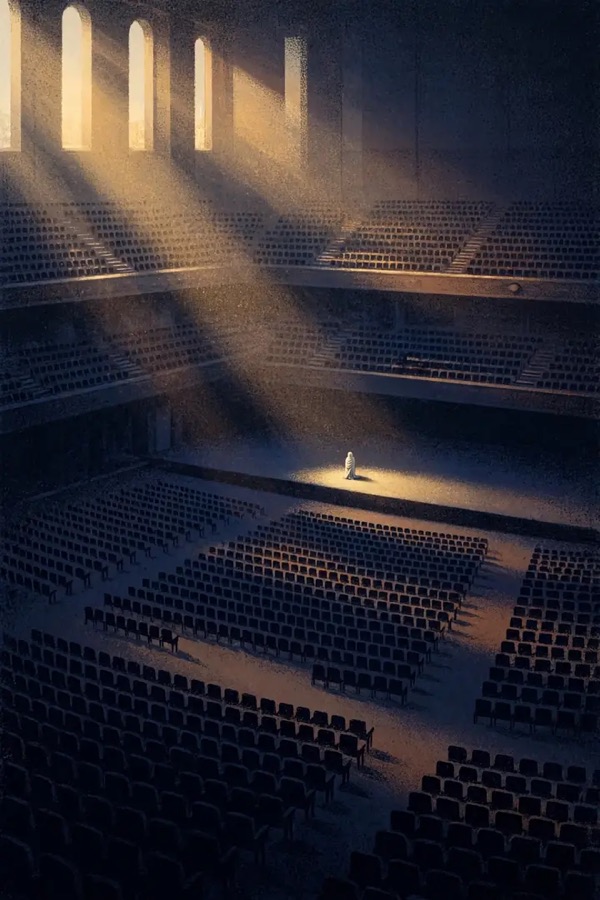
What does a dream about “Being naked in public” mean?
What psychologists say
Under the continuity hypothesis, nudity dreams pick up waking worries about appearance, competence or privacy. They sit among the common typical themes, with no reliable difference between men and women. Many dreamers report that no one else reacts, which suggests the feeling is about self-consciousness more than real judgement.
Nielsen et al., 2003; Schredl & Hofmann, 2003
The Jungian reading
A Jungian reading sees nakedness as the persona, the social mask, falling away. It can be frightening, but it also points to authenticity: being seen as you are. Shame in the dream may show how much you rely on the mask.
Jung, 1964
In history and folklore
Freud described these embarrassment dreams in detail and noted the strange indifference of onlookers, which he linked to childhood memories of running around undressed without shame. Artemidorus read nakedness differently for different dreamers: freedom for some, exposure for others.
Freud, 1900; Artemidorus, Oneirocritica
How common is this dream?
32.6% of people in the study had had this dream. From a survey of 1,181 first-year university students in three Canadian cities. No. 19 of the 55 typical dreams.
Common versions of this dream
What if no one notices I'm naked?
That is the most common version and suggests the worry is mostly inside you.
What if I'm naked at work or school?
The setting points to where you feel exposed: competence at work, belonging at school.
What if I don't feel ashamed?
Comfortable nakedness can point to self-acceptance and freedom.
Had this dream? Tell it to Oneiros.
Oneiros reads your own dream, not a dictionary entry: what it was about, how it felt and what it may mean for you, and it notices when it comes back.
Oneiros offers reflective readings for self-discovery and entertainment. It is not a medical or psychological service.
Sources
- Nielsen, T. A., Zadra, A. L., Simard, V., Saucier, S., Stenstrom, P., Smith, C., & Kuiken, D. (2003). The typical dreams of Canadian university students. Dreaming, 13(4), 211–235. doi:10.1023/B:DREM.0000003144.40929.0b
- Schredl, M., & Hofmann, F. (2003). Continuity between waking activities and dream activities. Consciousness and Cognition, 12(2), 298–308. doi:10.1016/S1053-8100(02)00072-7
- Jung, C. G. (Ed.) (1964). Man and His Symbols. Aldus Books.
- Freud, S. (1900). The Interpretation of Dreams. (Typical dreams are discussed mainly in chapters V and VI.)
- Artemidorus of Daldis (2nd century CE). Oneirocritica (The Interpretation of Dreams). Translated by D. E. Harris-McCoy, Oxford University Press, 2012.